
You Missed the S Corporation Election Deadline. Here Is Whether the IRS Will Fix It.
Missing the S corporation election deadline triggers default taxation for the year, either as a C corporation or a partnership. Rev. Proc. 2013-30 provides a streamlined relief path, but the consistency requirement it depends on disqualifies most California owners before they ever file.
Han S Kim, CPA
7/7/20265 min read
You Missed the S Corporation Election Deadline. Here Is Whether the IRS Will Fix It.
I advise California business owners on S corporation elections and have secured relief for entities that missed the filing deadline, through the Rev. Proc. 2013-30 process and private letter ruling requests.
You set up a corporation or an LLC, decided S corporation treatment was the right call, and then the filing date passed. Maybe a prior preparer never raised it. Maybe the entity was formed online and nobody flagged the election. Either way, the deadline is behind you and you are wondering whether the treatment is lost for the year.
It usually is not. The IRS grants relief for late S corporation elections routinely, when the conditions are met. But "you can file it late" is half an answer, and the missing half decides whether the relief holds. The form is the easy piece. The relief rests on a clean reporting record, and that is what most owners have already compromised by the time they call.
If you are still deciding whether the election makes sense in the first place, that is a different question, and I have worked through the math for a California LLC owner in the California break even analysis most CPAs skip. This article assumes the decision is made and the date was missed.
What is the S corporation election deadline, and what does missing it actually trigger?
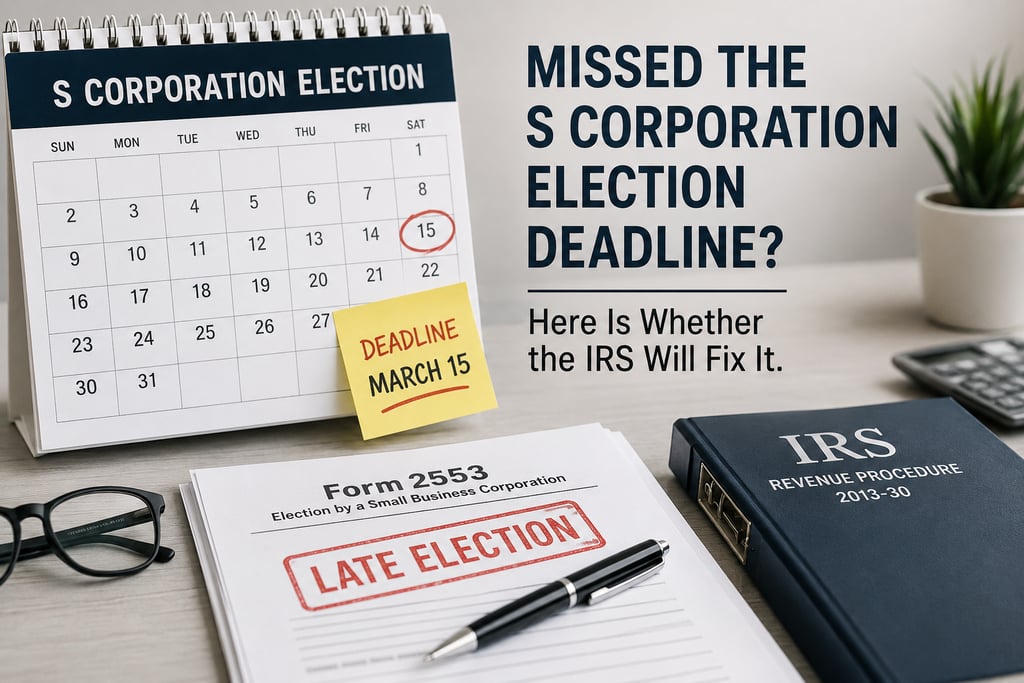
The election is made on Form 2553 under IRC Section 1362(a), and it is valid only if every person who is a shareholder on the day the election is made consents to it. The timing comes from IRC Section 1362(b)(1): the election has to be filed no later than two months and 15 days after the first day of the tax year it is meant to cover. For a calendar year entity, that date is March 15, or the next business day when it falls on a weekend or holiday.
Miss it and the statute applies the default. A corporation that intended S treatment is taxed as a C corporation for the year. An LLC that intended S treatment falls back to its default classification, disregarded for one owner or a partnership for two or more. The income is still taxed. It is taxed under the regime you were trying to leave, which usually means the full Social Security and Medicare tax on the profit, or the corporate level tax, that the election was meant to manage.
Does the IRS grant relief for a late election, and on what terms?
It does, under Revenue Procedure 2013-30, which replaced a series of earlier procedures with a single path through the IRS campus rather than a private letter ruling. Four conditions all have to hold. The entity was eligible for S status and failed solely because the election was not timely. There was reasonable cause for the failure. The entity and all of its shareholders reported income consistently with an S election for the missed year and every subsequent year. And fewer than three years and 75 days have passed since the intended effective date. A narrow exception can reach past that window, but the IRS notes it rarely applies, because the return rejects in processing and the corporation learns of the problem long before the window closes.
The mechanics are exact. The Form 2553 has to carry the words "FILED PURSUANT TO REV. PROC. 2013-30" in the top margin, and the reasonable cause statement goes on the form, signed under penalty of perjury. That statement is what secures Rev. Proc. 2013-30 treatment for the retroactive year. Leave it off and the filing falls under the default rule of IRC Section 1362(b)(3), which treats a late election as made for the following tax year. The missed year is not fixed by that filing, though it stays curable as long as you submit a complete relief request within the window. The statute the procedure implements, IRC Section 1362, is published on the Cornell Legal Information Institute.
What does the reasonable cause and consistency requirement actually demand, and where do these filings fall apart?
This is where the relief stops being a form and becomes a factual record. Start with reasonable cause, which is not "I didn't know." IRC Section 1362(b)(5) conditions relief on the Secretary finding reasonable cause for the late filing. Rev. Proc. 2013-30 adds a procedural layer the statute does not: the entity must also have acted diligently to correct the mistake once it discovered it. A statement that reads as an admission of inattention draws a request for more information, which costs months. The cause has to be specific and it has to be true.
Consistency is the harder condition, and the one I see fail most often. Relief requires that the entity and every shareholder reported income as if the S election had been in place for the missed year and each year after. In practice, an owner misses the election, then files the first year as a single member LLC on a Schedule C, or files Form 1120 as a C corporation, or takes no W-2 wage because he did not think he was running an S corporation yet. Each of those is a return filed inconsistently with the S election he now wants to claim. The relief depends on a record he has already contradicted.
There is also a consent point most people miss. Revenue Procedure 2013-30 requires the late Form 2553 to be signed by everyone who held stock at any time between the intended effective date and the filing date, not only the current owners. If a shareholder joined and left during the gap, you need that person's signature. Reaching a former owner who has no stake in the result is not a clerical task. It is a negotiation.
At this point the question is no longer which form to file. It is whether the relief can be supported on the facts. That is a judgment call with real exposure. A rejected relief request can push you out of the streamlined process and into a private letter ruling with a fee in the thousands, plus amended federal and California returns for every year the filings were inconsistent, all of which costs far more than perfecting the election once. This is the kind of analysis my tax advisory practice handles, and it is neither fast nor mechanical.
Does California require its own late election, or does federal relief cover it?
California generally does not require a separate state election. Under R&TC Section 23801(a), a corporation with a valid federal election under IRC Section 1362(a) is treated as having made a California S election on the same effective date. The FTB's own S Corporation manual is explicit that the only requirement is a valid federal election in effect.
So California appears to take care of itself, and mechanically it does. R&TC Section 23801(h)(1) extends the federal late election authority to the state, so when the IRS grants relief the California election is recognized as of the same date. No second form. No second reasonable cause statement.
The trap is in that automatic conformity. Because the state election rides on the federal one, the consistency requirement rides with it. Federal relief turns on whether all returns were filed consistently with the election, and all returns includes the California ones. An LLC owner who filed Form 568 as a partnership during the gap, rather than Form 100S as an S corporation, has not created a separate state issue to clean up later. He has damaged the same consistency record the federal relief depends on.
What happens if you fall outside the window or break a condition?
Once more than three years and 75 days have passed, or a condition cannot be met, the campus route under Revenue Procedure 2013-30 closes. The same relief authority under IRC Section 1362(b)(5) remains, but only through a private letter ruling, requested under the IRS's annual letter ruling procedure, currently Revenue Procedure 2026-1 and renumbered each January, with a user fee in the thousands and a wait measured in months.
The longer a missed election sits, the harder and costlier it is to fix. Streamlined relief exists because the IRS would rather accept a consistent return history than fight over an entity's status. What it will not do is rebuild a record you never kept. Once the election is fixed, the work shifts to keeping it valid, beginning with the reasonable compensation the election now requires, which I have written about in the second problem an S corporation salary creates.
Contact
Get in touch for expert advice.
Follow
Work with me
© 2026. All rights reserved.
Privacy Policy | Terms of Use
From tax filing to tax strategy, the next step is a conversation.
In-person consultations available: Los Angeles & Irvine (by appointment only)
한국어 가능