
Why Small Tax Errors Become Permanent Problems Over Time
Small tax mistakes rarely disappear. Learn how basis errors, carryforwards, and cumulative reporting issues quietly compound over time and limit future tax options.
Han S Kim, CPA
2/2/20264 min read

Why Don't Tax Errors Disappear When You File the Next Year's Return?
Most business owners assume each tax year is a fresh start. File it, close the books, move on. If something was off last year, next year's return will not know the difference.
That assumption is wrong, and it is one of the more costly misconceptions I run into when reviewing returns that have been with the same preparer for several years without a second look.
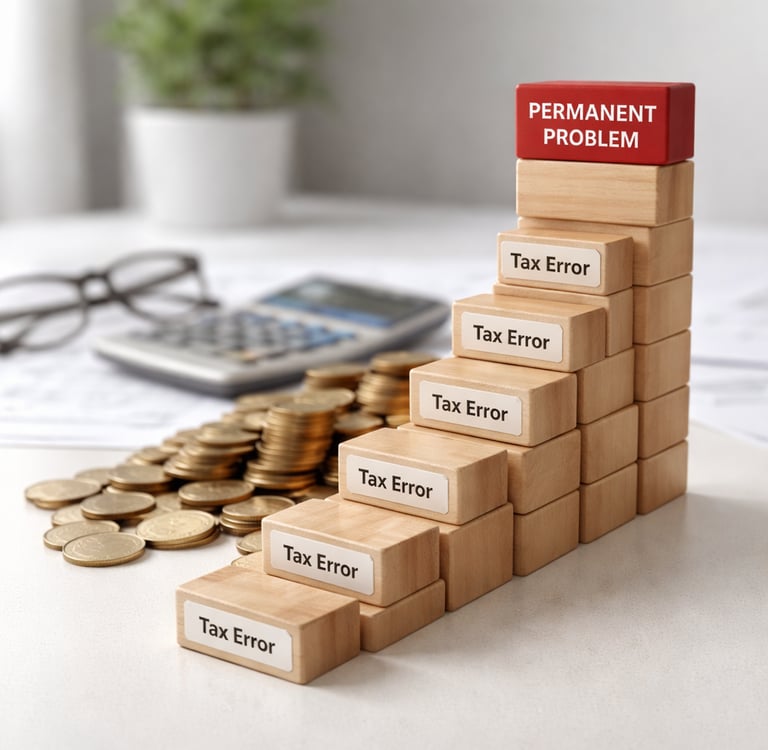
Large portions of the tax code are cumulative. Basis calculations, loss carryforwards, depreciation schedules, and credit balances do not reset at December 31. They carry forward from the prior return and build on whatever number was recorded there. Tax software does not verify prior-year inputs — it accepts them and keeps calculating. An error from year one embeds itself in year two's return, then year three's, each filing looking complete while the underlying number drifts further from reality.
The IRS works the same way. A figure that goes unchallenged for three years starts to look legitimate simply because it survived. The system is built on consistency. Accuracy is the owner's problem.
How Does Basis Function as the Control Variable Across Multiple Tax Years?
Basis is the starting point for more calculations than most business owners realize. It is also where I find errors most consistently — figures that have been rolling forward undetected, sometimes for the entire life of the entity.
S corporation shareholders track stock basis and debt basis under IRC §1367, adjusted annually for income, losses, contributions, and distributions. Partnership owners track outside basis under IRC §705, tied to capital account activity and debt allocations. In both cases, basis controls whether losses are currently deductible or suspended, whether distributions are tax-free or generate taxable income, and what gain or loss is recognized when an ownership interest changes hands.
An incorrect basis figure does not announce itself in year one. It runs quietly through every calculation that depends on it. Losses that should have been deductible get suspended under IRC §1366. Distributions get mischaracterized. Exit gain calculations come out wrong when someone finally runs them. None of these problems generate IRS notices while they are accumulating. They surface when a transaction forces a reconciliation — at sale, at restructuring, or when a lender requires a clean tax history as a condition of financing.
For individual taxpayers holding appreciated assets, basis under IRC §1011 controls gain recognition at disposition. A basis error at acquisition — a missed step-up, an incorrect purchase price allocation — produces an overstated gain at sale. The return in the sale year looks correct. The error was inherited, not created there.
Why Do Carryforward Balances Amplify Errors Instead of Correcting Them?
Carryforward items exist to preserve tax attributes across years. They work correctly only if the starting balance is accurate.
Net operating losses carry forward under IRC §172. Passive activity losses carry forward under IRC §469 until the taxpayer disposes of the activity or generates enough passive income to absorb them. AMT credit carryforwards accumulate under IRC §53 and offset future regular tax. In each case the software populates next year's balance from this year's ending number. No independent verification happens.
If a passive loss carryforward was overstated four years ago because an activity was misclassified or a basis limitation was ignored, that overstatement is still reducing taxable income today. The current return looks fine. Nobody examining only the current year would see it.
I have taken over accounts where carryforward balances were wrong at the origin point and had been rolling forward unquestioned for years. Correcting them is not a matter of amending one return. You have to go back to where the error started, which is rarely where the client thinks it started.
What Does It Actually Take to Fix a Structural Tax Error After Several Years?
More than most people expect, and sometimes more than it is worth.
Amended returns are needed for each open year under IRC §6501, which generally runs three years from the original filing date but extends to six for substantial omissions. Beyond that, the records required to reconstruct the error may not exist anymore — original capitalization documents, contribution histories, depreciation schedules from prior software, workpapers from preparers who are no longer involved. Recalculating interdependent attributes has to happen in sequence. Correcting year four means first correcting year three.
Some years are already closed under the statute. The error there is permanent. Others are technically open but the fees involved approach or exceed the tax benefit of the correction. At that point the question shifts from whether the error can be fixed to whether fixing it makes sense. I have had that conversation with clients. It is not a satisfying one.
When Do These Errors Actually Cause Visible Damage?
Rarely in the year they occur. Almost always when something significant is on the line.
Business sales, ownership transfers, and financing transactions force a reconciliation that routine annual compliance never requires. An owner who has filed clean returns for a decade discovers at closing that suspended losses cannot be released, that basis does not support a distribution taken two years earlier, or that depreciation recapture under IRC §1245 is larger than projected because cost basis was wrong from day one.
These are not unusual outcomes. They are predictable. Small errors at origin become expensive problems at discovery, and the gap between those two moments is where accurate recordkeeping and basis tracking earn their value. Most owners find out which category they are in at exactly the wrong time.
For IRS guidance on recordkeeping requirements for business taxpayers, see IRS recordkeeping guidance for small businesses.
If cumulative tax accuracy across prior years is a concern before a transaction or ownership change, that review is part of the tax advisory services.
Han S. Kim, CPA, EA, MST is a tax advisor based in California. This post is for educational purposes only and does not constitute legal or tax ad.
Contact
Get in touch for expert advice.
Follow
Work with me
© 2026. All rights reserved.
Privacy Policy | Terms of Use
From tax filing to tax strategy, the next step is a conversation.
In-person consultations available: Los Angeles & Irvine (by appointment only)
한국어 가능